

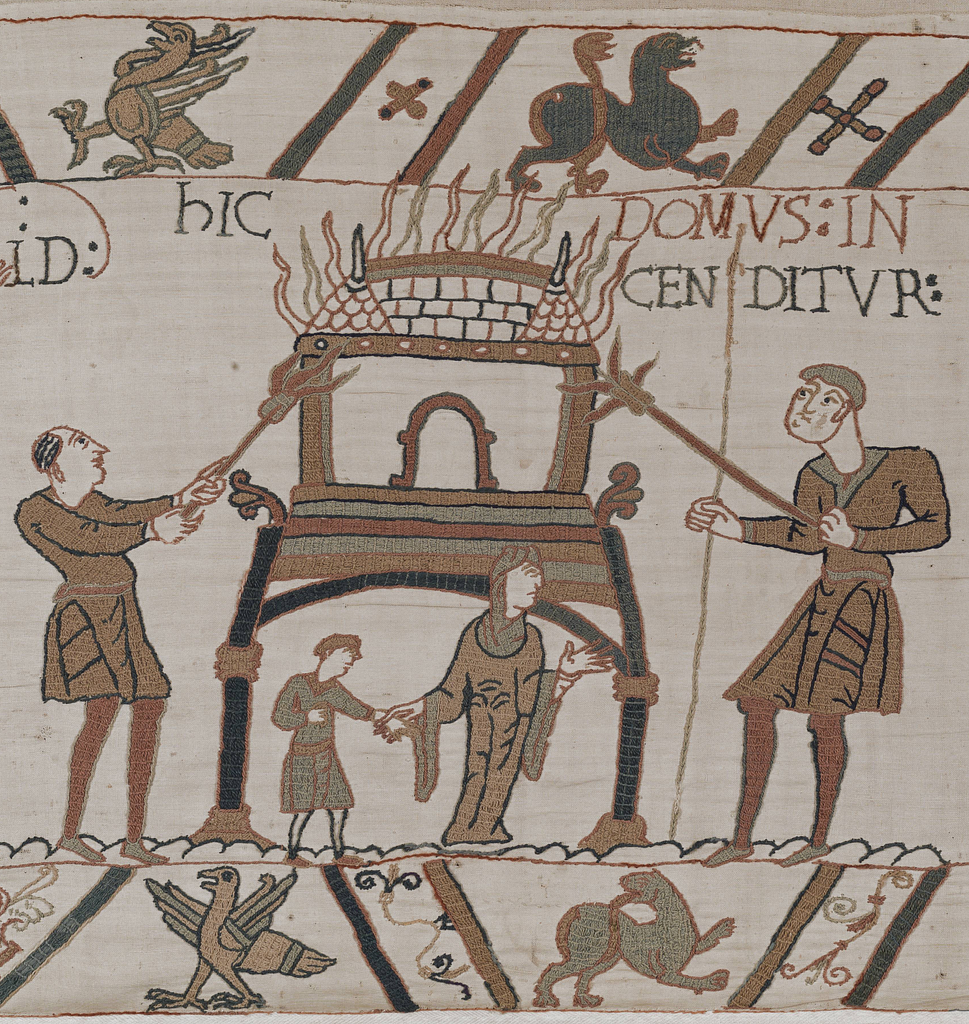
The Bayeux Tapestry is back in town! The 70m embroidery (not an actual tapestry) depicting the seminal battel of Hastings in 1066. Often looked at as a historical source for the Norman conquest, it gives us a rare insight into the views of the events from the perspectives of women.
Probably embroidered by nuns in Barking or Canterbury, it is a collaborative work, created in sections using a technique called pricking and pouncing, the same technique used on the Tredegar House mantua, in the National Welsh collection, around seven centuries later.
While The Bayeux Tapestry only depicts 3 women, 618 less than men, and 33 less then dogs, it shows the artistic freedom and character of the nuns shines in the margins of the tapestry. Showing scenes from Aesop’s fables, presenting a moral commentary on the events of the centre images a sort of ‘The Rest Is 1066’. This commentary was probably done relatively covertly because the tapestry was most likely commissioned as pro Norman propaganda and hung in Bayeux cathedral.
The perspectives of women in the Bayeux Tapestry can be seen in the depictions of women, which although scarce, portrays the effects of war on civilians and especially challenging ideas such as grief, assault, and displacement.
It is a prime example of the hidden perspective of historic women which can be found in textile work throughout the centuries. Such as in the Meni Bridge sampler by Mary Anne Hughs from 1826 (currently Housed in Bangor’s Storiel Museum), which ‘represents aspects of technological progress and industrialisation as seen by Welsh women’.
Embroidery was a central element of women’s education during the 18th and 19th centuries. Considered to be a way of conveying domesticity, occupation, and community as well as teaching some literacy. Embroidery has become ‘essential to understanding female identities’ during this period as well as throughout history.
Embroidery used by women as a form of discourse can be seen throughout the 18th and 19th centuries. For example in an embroidery sampler By Elizabeth Parker from 1830 in which she describes the past four years of her life recounting her experience of poverty, depression, and abuse at the hands of her employer. Textile work becoming an important tool for documenting the lives of women to easily lost to time.
Textile work and art can be profound and radical despite being often overlooked because of its association with women, the patriarchal hangover of an idealised domestic stereotype. Sometimes seen as a form of oppression enclosing women in ‘appropriate’ activities it has been subverted countless times. From Penelope in the Odessey weaving a funeral shroud, covertly wielding her loom as a weapon of wit while ostensibly conforming to social expectations, to Judy Chicago’s Dinner Party 1974-9 where she uses an overlooked and dismissed art form to give women a seat at the table.
